Why Britain Bears the Blame in a Much Older Human Story
Britain and Selective Memory
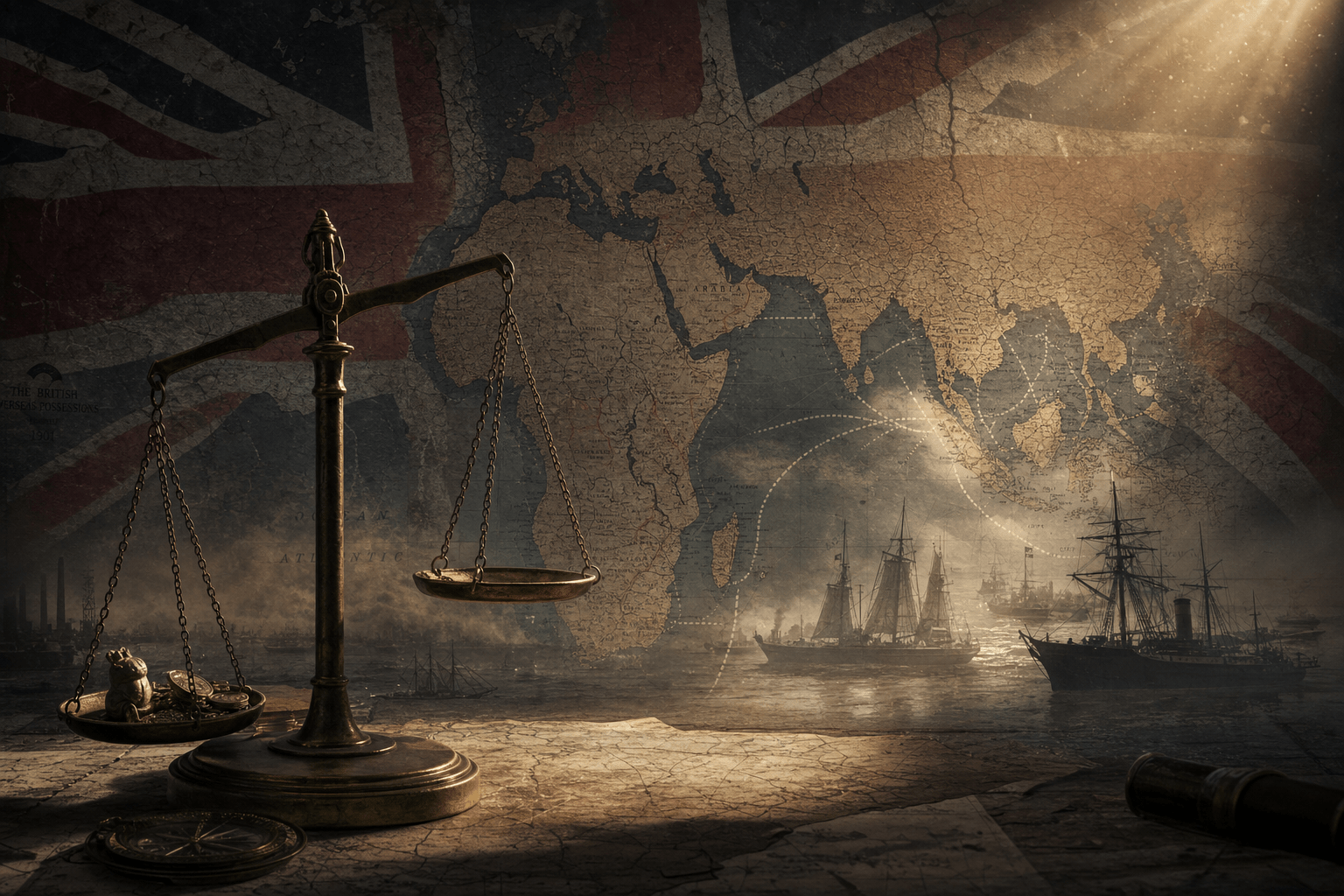
A Global Pattern of Empire and Exploitation
Britain has become the easiest villain in the modern argument about slavery, empire and the drawing of borders. That may suit a certain moral fashion, but it tells only part of the story: the trade in human beings, conquest by force and the redrawing of maps were not British inventions, and they were never confined to one civilisation.
A Comfortable Villain for an Uncomfortable Past
Few subjects are as politically useful as history, once it has been simplified enough to fit a slogan. Britain is often cast in that role with particular enthusiasm. Its empire was vast, its wealth was visible, its influence endured, and its record includes acts that can and should be judged harshly. That makes it an easy target. But the ease of the target is precisely the problem.
A serious account of slavery and colonisation cannot begin and end with Westminster, the Royal Navy or the British Raj. Human beings have been buying, selling, raiding, transporting and enslaving one another for thousands of years. Empires rose and fell on the same logic: the strong took what they could and justified it after the fact. Britain’s imperial age was brutal, but it took place inside a much older pattern, not outside it.
That distinction matters because public argument has a habit of turning history into a morality play. One nation becomes the actor and another the victim; one century gets condemned and the rest quietly disappear. The result is not clarity but evasion. If the object is to understand how domination works, the blame has to be broader than a single flag.
Britain did not invent conquest. It perfected certain forms of it at a particular moment, then left behind records, institutions and commercial wealth that later generations could identify and condemn. But the same moral scrutiny applied to Britain ought to extend to the rest of the world as well. The ancient Mediterranean had slaves. Arab armies expanded through military and political force. African societies, like European and Asian ones, participated in slave trading long before modern racial politics gave the subject its current vocabulary. Historical guilt is not a British monopoly.
Slavery Before Britain Became the Convenient Answer
The modern habit of assigning the slave trade to Britain alone collapses chronology. Long before British merchants entered the Atlantic economy, slavery already existed across Europe, North Africa, the Middle East, Asia and the Americas. It was a tolerated institution in many societies, often defended on religious, military or commercial grounds. People were captured in war, seized in raids, taxed in kind or sold to settle debts. The shame of that history is not that one civilisation was uniquely wicked, but that so many were willing to accept the practice as normal.
The trans-Saharan slave trade was a centuries-long network of forced human migration across the Sahara Desert. Active from the 7th century through the early 20th century, it moved an estimated 6 to 10 million enslaved individuals from sub-Saharan Africa to the Arab world, North Africa, and the Middle East.
That does not diminish the scale of the Atlantic slave trade or the responsibility of those who profited from it. Britain was central to that system for a long period and accumulated enormous wealth through it. But the habit of singling Britain out as though it stood outside all earlier history is intellectually thin. It treats one empire as if it emerged from nowhere, in a moral vacuum, and then polluted a pristine world.
The truth is less comforting. Slavery was a recurring feature of organized human life. It appeared wherever power was concentrated enough to make the weak vulnerable. That reality is inconvenient for modern campaigns that want a tidy villain, because it forces the argument away from identity and toward structure. If slavery was a human institution rather than a national invention, then the question becomes not why Britain was bad, but why so many systems made coercion profitable.
That is a harder question, and a more honest one. It leads to trade, war, scarcity, religion, labour demand and the machinery of empire. It forces a reckoning with the fact that no civilization has a clean record. Every great power has taken part in some version of the same bargain: wealth in exchange for domination, order in exchange for violence, prestige in exchange for other people’s freedom.
Britain’s place in that story is undeniable. But so is the danger of making Britain the whole story.
The Forgotten Trade Across the Sahara
One of the strongest reasons the standard story feels incomplete is that the Atlantic trade is only one part of a much larger history. For centuries, enslaved people were moved across the Sahara and through the Arab world in networks that were vast, durable and often ignored in Western debates. Those routes connected sub-Saharan Africa to North Africa, the Middle East and beyond. They involved raids, forced marches, sale, servitude and sexual exploitation on a scale that should not be treated as a footnote.
This is not an exercise in competitive suffering. It is an argument against selective memory. If a society is prepared to condemn the Atlantic system while pretending other systems were minor or benign, then its moral language is already compromised. The trans-Saharan trade was not a side note in African history; it was one of the great slave systems of the premodern world. It shaped populations, economics, politics, and violence across a wide region for generations.
Yet in many public discussions, this history barely appears. When it does, it is often treated as an awkward complication that might distract from the preferred narrative. That is an astonishing act of forgetfulness. It suggests that the point is not to understand slavery but to allocate blame in a way that flatters present-day orthodoxies.
The same problem emerges in the way colonial history is discussed. Britain is said to have imposed borders, divided continents and left behind instability. In many cases, there is truth in that charge. But the argument is too often framed as if arbitrary borders were a British specialty. In reality, every imperial power drew lines according to its own interests, and local rulers did the same whenever they had the strength. Borders are not a moral invention of one country. They are what politics looks like when power wins.
To mention the trans-Saharan trade is not to absolve Britain. It is to restore proportion. A civilization that looks only westward when judging evil is not being moral; it is being selective.
Islam, Empire and the Missing Conversation
A still more delicate omission concerns the expansion of Islam, which is rarely discussed in the same language used for European empire, even though it also spread through conquest, rule and cultural transformation. That fact does not turn Islam into some unique historical offender. It simply places it where all great civilizations belong: inside the ordinary, ugly record of human expansion.
Empires do not announce themselves as empires. They speak of order, civilization, faith, law and protection. That was true of Britain. It was true of Rome. It was true of the caliphates, Ottoman expansion and countless local kingdoms that grew by force. The language changes. The pattern does not.
In modern debate, however, some expansions are treated as historical necessities while others are treated as permanent moral stains. European conquest is presented as if it sprang from a particularly poisonous Western spirit. Non-European conquest is more often treated as context, destiny or the natural spread of civilization. That asymmetry tells us a great deal about the politics of memory.
The point is not to compare every empire in a crude league table of guilt. The point is to reject the false idea that only Europe had an imperial past worth condemning. Asia, Africa and the Middle East all contain histories of expansion, subjugation and forced conversion or assimilation. The idea that one region alone is responsible for the world’s violence is not history. It is a moral fashion statement.
This matters because the language of guilt now shapes education, diplomacy and public monuments. If one set of empires is said to be inherently criminal while another is left to escape serious scrutiny, the result is not justice but distortion. The public learns to recognise one form of power and remain blind to the rest.
Britain should be judged severely where it deserves it. But the standard should be universal, not tribal. Otherwise the judgment is merely another form of prejudice, dressed up as conscience.
The Border Problem Is Bigger Than Britain
One of the most familiar charges against Britain is that it drew arbitrary lines on maps and left behind chaos. In some regions, this accusation is more than fair. Imperial administrators, like many rulers before them, often drew borders to suit trade routes, military control or administrative convenience. Those borders sometimes ignored ethnic, linguistic or religious realities and helped produce future conflict.
But there is something deeply misleading about pretending that Britain invented the practice. Every European power drew borders whenever it could. So did Arab, Ottoman, Persian, Indian, Chinese and African rulers. The map is not a British toy; it is a record of power. Whenever a state could mark territory, it did. Whenever it could divide a rival or consolidate control, it did. Whenever conquest succeeded, lines appeared.
The complaint about Britain’s borders often depends on an idealization of everyone else. It imagines that local political orders were natural, harmonious and authentic until a foreign surveyor arrived. That is a fantasy. Many precolonial states were themselves products of conquest, migration and coercion. Many frontiers were fluid, contested or understood in ways very different from modern nation-states. The arrival of European mapping did not create political conflict from nothing. It often hardened existing rivalries into new administrative forms.
This does not let imperial powers off the hook. They were frequently reckless, cynical and self-serving. But it does mean that border disputes, ethnic tensions and territorial fragmentation cannot be reduced to one imperial act. History is rarely that neat.
The obsession with British map-making also carries a hidden implication: that if Britain had behaved differently, the modern world would have emerged intact and orderly. That is nonsense. Colonial borders persist because postcolonial states inherited them, adapted them and often found them useful. Independence did not erase the map; it kept it. New governments sometimes defended those borders not because they loved imperial history but because alternative arrangements risked civil war.
Blaming Britain alone is convenient. Explaining the world is harder.
Why the Moral Narrative Took Hold
If the historical record is so mixed, why does the simplified version dominate so many institutions? The answer lies partly in politics and partly in the appetite for a clear moral hierarchy. Western societies, especially Britain and the United States, have spent decades wrestling with the contradiction between democratic ideals and imperial or racial histories. That struggle has produced valuable self-criticism. It has also created a market for public guilt.
Guilt is a powerful organizing force. It offers a way for modern elites to signal virtue without having to resolve deeper political questions. Condemning ancestors is easier than confronting present inequalities, present wars or present forms of coercion. It also offers an uncomplicated narrative for universities, broadcasters and activist movements: a story of oppressors and oppressed, with enough familiarity to be repeated on command.
There is a practical reason Britain features so often in these arguments. Britain was a major imperial power, but it is also a liberal democracy with a lively culture of self-reproach. It is easier to attack a society that will hold the debate in public than one that suppresses it. In that sense, the country’s openness becomes part of its burden. Britain can be scolded because Britain will listen.
That does not make the criticism false. It makes it selective. Other empires have committed their own crimes, but many of them are protected by nationalism, censorship or simple distance from the institutions that shape Western debate. Britain, by contrast, remains visible, document-rich and symbolically useful. The archives are available. The monuments are standing. The argument can always be renewed.
The danger is that public memory becomes less a search for truth than a system for distributing shame. Once that happens, the past stops being a field of inquiry and becomes a moral resource. It can be mined for claims, rhetorical points and political leverage. The result is not historical understanding but a permanent tribunal.
What Is Lost When History Becomes Branding
When Britain is reduced to a shorthand for slavery and colonial oppression, several things disappear at once. The first is comparison. Without comparison, there is no scale. Crimes are flattened, differences vanish, and the public is encouraged to think in symbols rather than structures.
The second is agency. Millions of people across continents participated in, resisted, adapted to or profited from systems of domination. To treat all of that as if it were authored solely by Britain is to strip other actors of responsibility. Local rulers, merchants, intermediaries, military elites and collaborating communities all had roles. Some resisted foreign rule; others sought advantage within it. Human history was never a duel between the British and the rest of the world.
The third is continuity. Slavery did not vanish because one empire declared it immoral. It declined through economic change, military pressure, religious argument, political reform and, in many places, sheer exhaustion of old systems. Colonial rule did not end the moment independence was proclaimed. New states inherited bureaucracies, borders, debts and divisions. The past did not stop at the moment the moral verdict was delivered.
There is also a cost to moral overreach. If public culture insists on presenting Britain as the source of nearly all modern injustice, it invites cynicism. People notice when the story is too simple. They notice when one set of crimes is condemned loudly while others are omitted or excused. Once that happens, the argument for historical responsibility weakens because it begins to look performative.
A more serious approach would accept a plain truth: Britain’s empire was among the most consequential in modern history, and it was often cruel. It was also part of a wider human pattern that included older slave systems, wider imperial expansion and the routine drawing of political lines by force. To say that is not to defend Britain. It is to defend history against propaganda.
The Need for Proportion, Not Amnesia
The strongest case against the fashionable blame game is not that Britain should be exonerated. It is that history should not be edited for convenience. Britain, like every major power, has blood on its hands. It also has a complex record of abolition, reform, administration, exploitation and self-criticism. The same country that profited from empire also produced some of the institutions and arguments that later helped dismantle slavery and imperial rule. History is not a morality tale in which each nation keeps one fixed identity forever.
That complexity should make public debate more careful, not less. When a country is told that all its historical sins belong to one civilization and none of its achievements count, the conversation stops being scholarly and becomes liturgical. That may feel righteous. It does not help anyone understand the world.
A better public argument would begin with three simple propositions. First, slavery was older and more widespread than the modern West likes to admit. Second, Britain was deeply implicated in it and cannot be excused. Third, Britain was not alone, and any serious reckoning must include the full range of human systems that made enslavement possible.
The same rule applies to colonial borders. Yes, Britain drew lines that still cause trouble. No, it did not invent the practice, and no, every present dispute cannot be traced to one imperial decision. The world was carved up by conquerors of many kinds, and many of those lines survived because later rulers found them useful.
History does not become less moral when it becomes more accurate. It becomes more moral. Selective outrage is easy. Proportion is harder. But only proportion can survive contact with the facts.
Why the Argument Still Matters Now
These disputes are not merely academic. They shape school curricula, museum labels, foreign policy language and the way nations imagine themselves. They also influence how younger generations are taught to think about guilt, identity and political power. If history is presented as a list of offenses committed by one civilization against a passive world, then the lesson is falsified at the start.
The consequences are visible in public life. Some people come away believing the modern world was made by one region’s evil alone. Others retreat into denial and insist that imperial history needs no serious accounting at all. Both reactions are mistakes. One turns history into accusation; the other turns it into amnesty. Neither is worthy of a serious country.
Britain should not be placed beyond criticism. It should also not be transformed into the universal debtor for all of history’s sins. The world was built by many hands, and many of those hands were stained. The British Empire mattered because power matters. But power was never British property alone.
That is the uncomfortable point hidden inside the more theatrical versions of historical blame. The past is not a court in which one defendant can absorb all guilt and allow everyone else to leave the room. It is a record of recurring human choices: conquest, trade, coercion, compromise and resistance. If the public is to learn anything useful from it, the lesson must be larger than national shame.
Britain’s record deserves scrutiny. So does everybody else’s. Anything less is not history. It is selective memory with a better vocabulary.
This post contains affiliate links. If you purchase through these links, I may earn a commission at no extra cost to you.
Leave a Reply