Why the Job-Catastrophe Narrative Misses the Point
AI Won’t Replace Human Work
Why the Job-Catastrophe Narrative Misses the Point
The loudest claims about artificial intelligence assume a simple ending: machines rise, people are displaced, and payrolls collapse. That is not how the economy usually works, and it is not how this wave of technology is likely to work either. The more plausible outcome is less dramatic and far more disruptive in a different way: AI will change what people do, how quickly they do it, and how many layers of routine work can be stripped away before a business notices the difference.
The panic is louder than the evidence
Every major technology arrives with a prophecy attached. The steam engine was supposed to erase stable work. The assembly line was supposed to reduce human labour to a handful of foremen and mechanics. The computer was meant to hollow out office employment. Then the internet was meant to make whole industries vanish overnight. None of those forecasts turned out cleanly. Jobs were lost, yes, but new tasks, new firms, and new demands appeared alongside the losses.
Artificial intelligence is being discussed in a different mood. The reason is obvious. Earlier technologies replaced muscle, and this one appears to imitate judgment, language, and the clerical work of the mind. That is unsettling. A machine that can draft a memo, summarise a meeting, and generate a client email does not look like a crane or a conveyor belt. It looks like a rival.
But the fact that a machine can imitate a task does not mean it can absorb the full role that surrounds it. Most jobs are not a single repeatable act. They are a bundle of duties, compromises, context, and responsibility. The accountant is not only adding numbers. The lawyer is not only drafting clauses. The editor is not only rearranging words. The manager is not only issuing instructions. A useful machine can take pieces of those jobs. It can even take large pieces. That is not the same thing as wiping out the work altogether.
The public debate often confuses task substitution with job elimination. That confusion is convenient for those selling doom. It also flatters those selling salvation. Both extremes offer a clean story, and the real economy rarely cooperates with clean stories.
What automation usually does first
The first effect of a new general-purpose technology is not mass job destruction. It is pressure on routine work. AI is already strongest where the task is bounded, repetitive, and easy to verify. It can sort customer queries, tag documents, draft first-pass text, extract data from invoices, and suggest code. Those are real gains. They also target the least distinctive parts of many white-collar jobs.
That matters because businesses do not need to eliminate entire occupations to extract value. They can compress time. They can reduce error. They can let one employee do the work that used to require two. They can hold headcount steady while output rises. In accounting firms, publishing houses, insurance offices, call centres, and software teams, that is the more immediate story.
It is also why the unemployment panic can be misleading. A firm that adopts AI does not necessarily fire the whole department. It may stop hiring. It may shrink through attrition. It may shift workers toward client-facing tasks, oversight, or higher-value judgement. That kind of adjustment is harder to count than a layoff notice, which is why it is often missed in the early debate.
The labour market absorbs shocks unevenly. Some workers are pushed out. Some are promoted into new work. Some are simply left to do more with less. The outcome depends on the industry, the regulatory climate, the level of competition, and how fast customers expect service. A small shop, a law firm, and a multinational bank will not use AI in the same way. Yet the common pattern is clear: technology tends to reorganise labour before it removes it.
That does not make the transition painless. It means the damage is likely to show up as pressure, wage stagnation, sharper performance demands, and fewer entry-level openings long before it shows up as a headline unemployment crisis.
The office is more exposed than the factory
The deepest anxiety about AI comes from a simple fact: the technology does not only threaten manual work. It reaches into offices, studios, schools, and newsrooms, the places long considered safe from machine competition. That is why the debate has become so emotionally charged. For a century, the prestige of knowledge work rested in part on the belief that language, analysis, and creativity sat beyond the reach of automation.
That belief is now weaker. Language models can produce competent prose in seconds. They can organise research notes, propose outlines, and turn fragments into something that looks like finished work. For a manager looking to cut costs, that is enough to trigger a rethink. If a junior employee used to spend half a day assembling a report that AI can produce in ten minutes, the organisation will ask an obvious question: does it need as many people performing that task?
Yet the answer is not always yes or no. Often the answer is that the organisation needs fewer people doing the drafting and more people checking, refining, and deciding. The value shifts upward. The work becomes less mechanical and more supervisory. That is one reason the strongest users of AI are often not the people most eager to replace staff, but the people who want to accelerate them.
The office is also where replacement claims run into a hard limit: trust. Firms do not buy output alone. They buy reliability, confidentiality, accountability, and the ability to answer when things go wrong. AI can write a draft. It cannot be cross-examined in the same way a person can. It cannot be fired in a legal sense, disciplined, or held morally responsible. That matters in every serious institution.
A bank can use AI to flag risk. It still wants a human to sign off. A hospital can use AI to sort records. It still wants a clinician to decide. A publisher can use AI to propose wording. It still wants an editor to carry the judgment. The more the work touches money, liberty, health, or reputation, the more likely human oversight remains essential.
Why human judgement still commands a premium
The strongest argument against mass unemployment is not sentimental. It is economic. Many tasks are cheap to automate only when the cost of a mistake is low. Once the stakes rise, human judgement becomes expensive precisely because it is scarce and harder to copy.
A model can generate a polished answer, but it does not know when the answer is dangerous, unfair, illegal, or simply foolish unless those constraints are supplied and enforced. It can imitate confidence without understanding consequences. That is tolerable for a draft blog post. It is not tolerable for a regulatory filing, a medical recommendation, or a criminal investigation.
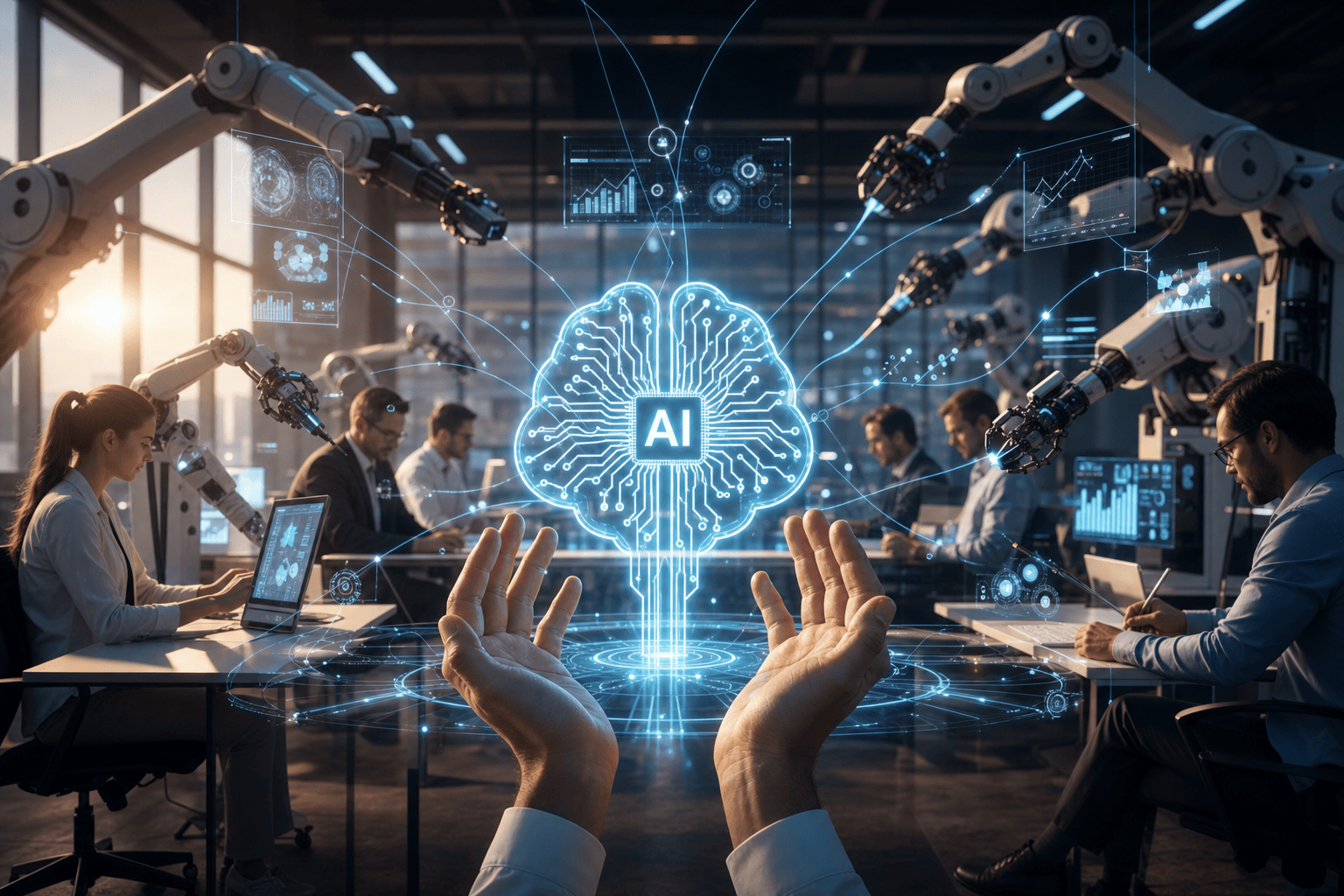
This is where the idea of AI as a magnifier matters. A magnifier does not abolish the eye. It helps the eye see farther, faster, or with more precision. The same is true here. The most productive uses of AI are likely to be those that extend human reach rather than remove human control. That is especially true in fields where the worker’s real value lies in diagnosis, taste, prioritisation, negotiation, or responsibility.
A good editor does more than correct grammar. A good lawyer does more than fill in forms. A good manager does more than relay instructions. A good scientist does more than run calculations. AI can help with all of these functions, but the human element is not decorative. It is central.
The labour market reward for that kind of judgment may even rise. When machines handle more of the routine, the human who can ask better questions, reject bad outputs, and make final calls becomes more valuable. That should be welcomed, not feared. It means the economic system still places a price on human judgement.
The danger is not that AI will make people useless. The danger is that it will make mediocre, purely routine work less valuable, while increasing the premium on competence. That is a harsh adjustment, but it is not the same as unemployment on a mass scale.
The real threat is not joblessness but squeezing
If the public debate is wrong about unemployment, it is also wrong about comfort. The absence of a mass layoff wave does not mean the technology will be benign. It may simply mean the pressure is distributed in less visible ways.
The first is wage compression. When a tool makes one worker more productive, the employer does not have to share all the gains. Some of the benefit becomes profit. Some becomes a lower cost base. Some becomes a requirement to produce more in the same number of hours. Workers may find that they have not lost their jobs but have lost bargaining power.
The second is entry-level erosion. If AI can do the easiest first drafts, the simplest coding tasks, the basic research, or the routine customer correspondence, employers may decide they need fewer trainees. That matters because every profession depends on a ladder. If the bottom rung is weakened, the whole structure becomes harder to climb.
The third is management by metric. Once a machine can produce a first pass quickly, bosses tend to expect quicker response times from people too. The standard rises. The pace quickens. Workers are told that because the software can do part of the task, they should now handle more of the rest.
The fourth is a shift in skill demand. Some people will thrive. Others will struggle. The market will reward those who can combine judgment with technical fluency, and it will penalise those trapped in repetitive execution. That is not a catastrophe in the abstract, but it is a serious distributional problem.
This is why the discussion should move away from a crude yes-or-no question about whether AI destroys jobs. It should instead ask which tasks are being stripped from which jobs, who captures the productivity gains, and how quickly institutions adapt. That is a harder conversation, but it is the one that matches reality.
History suggests adaptation, not collapse
The historical record is not a guarantee, but it is a warning against prophecy. New technologies often destroy specific roles while creating broader categories of work around them. They also take time. The time lag matters. It allows firms, workers, schools, and regulators to adjust.
When electricity spread through industry, factories did not instantly become more productive. The machinery had to be redesigned around it. When computers arrived, offices did not disappear. They became more information-dense, more networked, and more dependent on digital systems. The impact was deep, but it was uneven and slow enough to be absorbed.
AI may prove different in degree, not in kind. It is faster to deploy than a factory redesign. It can be added through software rather than steel. It can affect service work without a single machine being installed on a shop floor. That makes the initial shock feel immediate. But even then, the economy does not snap like a dry branch. It bends, resists, and reconfigures.
The more relevant question is whether institutions can adapt at the same pace. Schools, licensing bodies, civil services, and large corporations are often slow. They like routine. They like fixed categories. They like last year’s job descriptions. That is where friction arises. A technology may be capable of replacing or reshaping work long before organisations are willing to redesign themselves around it.
The result can look like stagnation rather than displacement. People remain employed, but they are not as productive as they could be. Firms buy the software but fail to rethink the process. Workers use the tool but are not trained to exploit it. That is another reason the mass unemployment thesis is too simple. The binding constraint may not be labour demand. It may be management competence.
The jobs most likely to survive are not the glamorous ones
The public conversation often imagines a neat divide between low-skilled work that machines can do and high-skilled work that remains safely human. That is not the right map. Some of the most exposed jobs are in the middle of the income ladder, where the work is largely information processing but still repetitive enough to be codified.
Routine drafting, summarising, scheduling, translating, basic coding, support queries, and document review are all vulnerable. So are many workflows in procurement, compliance, marketing, and administration. These jobs may not vanish at once, but they are easy targets for partial automation.
By contrast, jobs that depend on physical presence, face-to-face trust, messy environments, and immediate accountability are harder to replace. Skilled trades, nursing, childcare, field service, and many forms of hands-on maintenance remain stubbornly human. So do roles where people pay for judgment under uncertainty rather than simple output.
That said, survival is not the same as immunity. Tradespeople may use AI for quoting and diagnostics. Nurses may use it for triage support. Teachers may use it for lesson preparation. None of that removes the human from the centre of the work. It merely changes the workflow.
This distinction matters because it shows where the real fault line lies. The relevant divide is not between manual and intellectual labour. It is between work that is rule-bound and work that is situated, embodied, and responsible. The more a job can be broken into predictable steps, the more pressure AI can apply.
That still does not translate neatly into mass unemployment. The service economy is enormous, but it is not made of identical widgets. It is made of judgment calls, exceptions, and human relationships. A machine can assist with many of those. It cannot fully absorb the fact that the customer, patient, client, or citizen still wants a person to answer for the result.
Productivity gains are not the same as replacement gains
One reason AI boosters and AI alarmists talk past each other is that they measure success differently. The booster sees productivity: more output, less time, lower cost. The alarmist sees substitution: fewer workers, fewer openings, less bargaining power. Both are partly right, but they are not making the same claim.
A technology can be economically transformative without producing a labour market collapse. In fact, the more successful it is at making workers productive, the less incentive firms have to remove all of them. A firm that can produce more with the same staff may prefer to keep those staff and expand output, or enter new markets, or raise service levels. That is especially true where demand can grow.
The classic fear of automation assumes a closed pie. It imagines that if machines do more, humans must do less. But economies are not closed in that way. Lower costs can generate more demand. Faster work can create more projects. Better tools can create new expectations. A business that answers customer enquiries faster may win more clients. A law firm that drafts faster may take on more matters. A newsroom that researches faster may produce more coverage.
That is not a defence of every use of AI. It is a reminder that technology often expands production rather than merely replacing labour. The result can be a company with the same headcount, or even more headcount, but much higher output.
This is why the phrase “human-intelligent magnifier” is more than a slogan. It captures the most realistic economic role for the technology. It magnifies the best human operators. It does not abolish the need for them. The businesses that understand this will not use AI to strip people out blindly. They will use it to sharpen the people they already have.
The smartest firms will redesign the work, not just the headcount
The difference between a useful AI deployment and a destructive one lies in management. Bad management sees a machine that can draft and immediately asks how many people can be removed. Better management sees a machine that can draft and asks how the entire process should change.
That distinction is crucial. If AI is inserted into a broken workflow, it only speeds up the breaking. If it is used to redesign the workflow, it can make the organisation faster, leaner, and more capable without stripping out the human judgment that gives the work value.
The most successful companies are likely to treat AI as an internal utility, not a replacement fantasy. They will use it for first passes, pattern finding, search, and routine assembly. Then they will reserve human time for decisions, exceptions, client contact, quality control, and strategic work. That is not an accident. It is the natural design of an organisation that understands where value really sits.
This also explains why the most credible advocates for AI do not talk about the end of human work. They talk about augmentation. They talk about copilots, not coups. They talk about people using the tool better, not disappearing behind it. The rhetoric may sound modest, but it is the only rhetoric that makes business sense across a wide range of industries.
A company that fires too many staff on the assumption that AI has solved labour often discovers, too late, that it has removed the very people who knew how to spot errors, calm customers, or keep the machine useful. The tool is only as good as the system around it. That system is still human.
Economists and technologists have circled related ideas under labels like the democratization of technology, accelerating adoption curves, and even extensions of the Jevons paradox, where efficiency gains or price drops don’t conserve resources or attention but expand total consumption.
The policy question is about transition, not panic
If AI is unlikely to produce mass unemployment, that does not mean policymakers can relax. The appropriate response is not complacency. It is preparation.
Governments should focus on job transition, training, and labour mobility. Schools should treat AI literacy as a basic workplace skill, not a novelty. Employers should be expected to use the technology to raise productivity without turning entry-level work into a dead end. Professional bodies should update standards so that human oversight remains real rather than ceremonial.
There is also a need for honesty. Policymakers should stop talking as if the only possible outcomes are utopia or collapse. The more likely path is a long period of uneven adjustment. Some sectors will adopt quickly. Others will lag. Some workers will gain. Others will lose leverage. Some firms will become dramatically more efficient. Others will waste money on tools they do not understand.
That is not a neat story, but it is the right one. It also helps explain why arguments about universal unemployment miss the point. The major issue is not whether there will be work. There will be work. The issue is who will do it, on what terms, with what level of training, and with how much human agency left in the loop.
A mature society should want a technology that expands capability rather than one that pretends to replace judgement. That is the standard AI should meet.
The human role is the point, not the problem
The temptation in every technological revolution is to imagine that the machine becomes the centre and the person becomes an accessory. That is backward. The machine has no purpose without human aims. It can accelerate a process, but it cannot decide what the process should be for.
That is why the most sensible view of AI is not mystical and not panicked. It is practical. Use it where it makes routine work faster, cleaner, and less expensive. Use people where the work requires judgment, responsibility, and trust. Build systems that let the two reinforce each other.
There will be real pain in some corners of the labour market. No serious observer should deny that. But the claim that AI will simply wipe out mass human employment rests on a crude reading of how work is organised and how economies change. Jobs are not single tasks. Firms do not replace judgment easily. Customers do not trust outputs blindly. Institutions move slowly. And humans remain the only actors who can meaningfully own the consequences.
That is the deeper lesson. AI can amplify human intelligence, but only if humans remain the ones directing it.
This post contains affiliate links. If you purchase through these links, I may earn a commission at no extra cost to you.
Leave a Reply