A Tragedy of the Right Colour: The Henry Nowak Murder and the Policing Crisis Nobody Wants to Discuss
When a Teenager’s Death Exposes the Fault Lines of British Justice
The brutal murder of 18-year-old Henry Nowak in Southampton has become the unlikely flashpoint for one of the most uncomfortable conversations Britain has faced in decades. It is a conversation about race, policing, justice, and whether the reforms designed to protect one community have inadvertently endangered another. What makes this case so explosive is not merely the violence of Nowak’s final moments, but what those moments reveal about how policing has been reshaped by decades of ideological transformation.
White people have searched for a case to adopt as their own George Floyd moment, but few opportunities have presented themselves. Even though Coleman Hughes did point out such cases contemporaneously with the death of George Floyd, that such egregious cases had happened to white people when ignored, they appear puzzled as to what was happening. But the elite have become blind to the plight of the white working class. Many of the modern concerns of the left—gender ideology, environmentalism, climate change, and borderless nations—are very low down the priority list for the working class of all ethnicities.
The Night That Changed Everything
Henry Nowak was a university student with his entire life ahead of him when he was stabbed to death in December. His attacker, Vikram Diga, was convicted and will spend decades behind bars. Yet the circumstances of Nowak’s death, and particularly the subsequent police response, have ignited a firestorm of public anger that goes far beyond the individual tragedy.
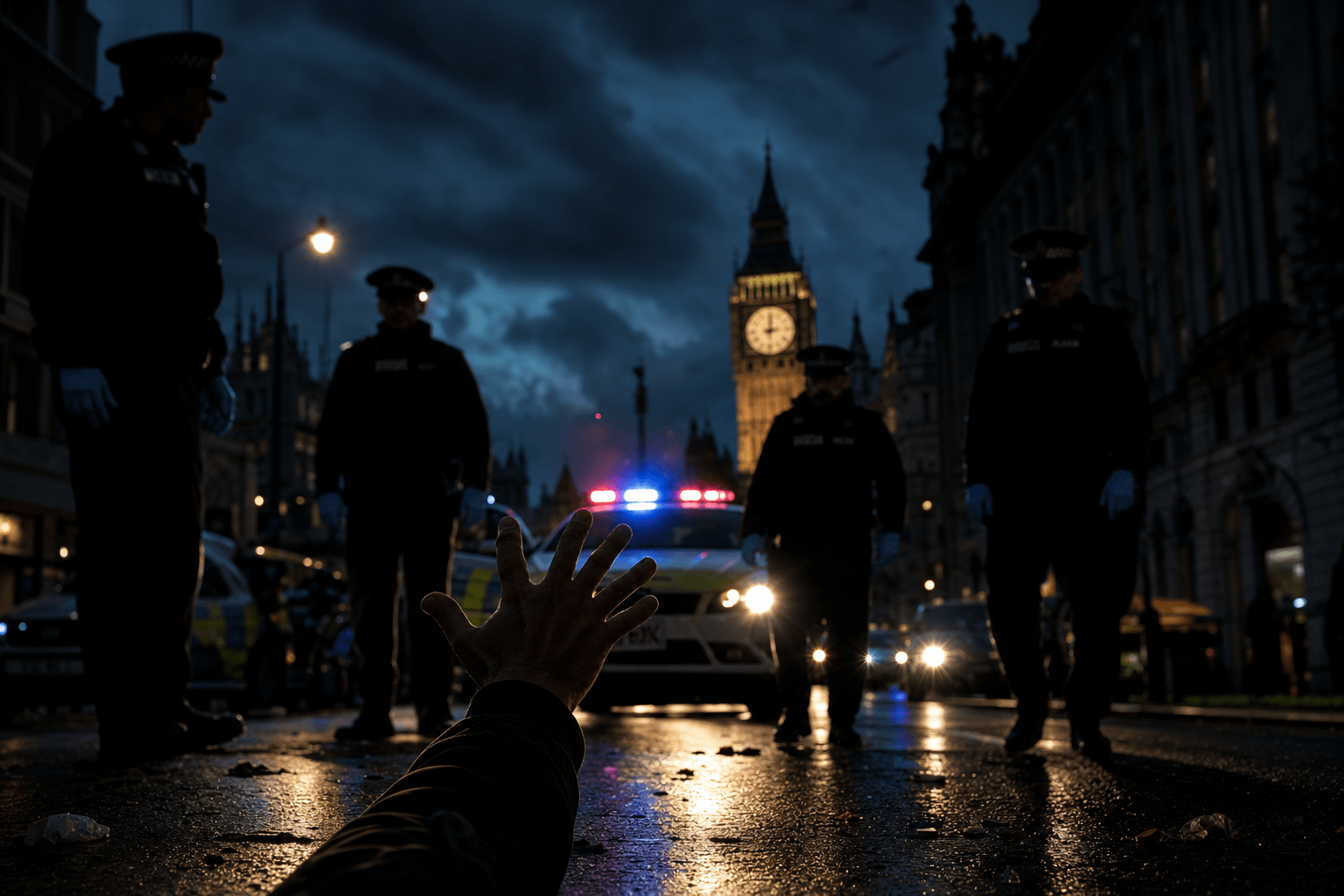
The details are now widely known. During his final minutes, Nowak told officers multiple times that he had been stabbed and could not breathe. Yet rather than receiving immediate medical attention, he was treated with suspicion by the very people whose job was to protect him. Bodycam footage shows officers handcuffing the dying teenager while investigating claims from his attacker about a supposed racist incident.
The Ghost of 1997 and the McPherson Report
To understand the Nowak case, one must look back to 1997, when Tony Blair’s Labour government commissioned an inquiry into the death of Stephen Lawrence. The subsequent McPherson Report, published two years later, became the foundational text for modern policing on race relations in Britain.
Lord McPherson’s inquiry made 70 recommendations and is widely credited with changing how British police approached racial incidents. But perhaps its most consequential finding was the redefinition of racism itself. The report stated that a racist incident could be defined as any incident perceived to be racist by the victim or any other person. There was no requirement to establish objective facts or cross an evidential threshold. If someone believed themselves a victim of racism, they were to be treated as such.
At the time, this seemed like progress. The police had been found wanting in their handling of Stephen Lawrence’s murder, and reforms were necessary to address clear institutional failures. But nearly three decades later, questions are being asked about whether these well-intentioned reforms have created a system where victimhood is assigned not by evidence but by perception, and where the very concept of institutional racism has been applied so broadly as to become meaningless.
Equity vs Equality: The Ideological Divide
The Nowak case highlights a fundamental tension between two competing concepts: equity and equality. Equality means treating everyone the same regardless of race, background, or circumstances. Equity, as currently practised by many British institutions, means treating people differently to achieve particular outcomes—essentially positive discrimination by another name.
The application of equity in policing has had profound consequences. NHS doctors have reported being under pressure not to section psychotic black patients to avoid appearing racist. Black people are 3.5 times more likely to be detained by mental health services than white people. In response, the NHS has rolled out positive discrimination policies that some doctors have criticised as “scientific illiteracy” and “jumping on bandwagons”.
This approach treats statistics not as diagnostic tools but as problems to be solved through differential treatment. The result is a system where the same behaviour might be judged differently depending on the racial identity of the person involved—a direct contradiction of the principle of equality before the law.
The Rise of Two-Tier Policing
The Nowak case has focused attention on what critics call two-tier policing: the perception that police respond differently to incidents depending on the racial identities of those involved. While the term is contested, the anger it represents is real and widespread.
In the Nowak case, critics argue, a dying white teenager was treated with suspicion while his attacker, who made claims about racial abuse, was initially treated as a potential victim. The bodycam footage shows officers questioning Nowak’s account even as he bled to death, seemingly more concerned with investigating potential racism than with saving a life.
This is not an isolated concern. The same critics point to other cases where police responses appear to have been influenced by racial considerations. The Rotherham grooming scandal, where predominantly Pakistani men abused young white girls over many years while police and social services turned a blind eye for fear of being accused of racism, is frequently cited as evidence that McPherson-era reforms have had dangerous unintended consequences.
The Manchester Arena bombing and the Southport stabbings are also raised as examples where warnings were missed because investigators were reluctant to be seen as racially profiling suspects. Whether these claims are fully justified is debated, but what is clear is that a significant portion of the British public believes institutional changes have made police less effective at protecting all communities equally.
Previous Cases That Could Have Been Rallying Points
The Nowak case is not the first example of a white victim whose death could have sparked a movement similar to Black Lives Matter. There have been numerous previous cases that, had they received similar media attention and political recognition, might have served as rallying points for those concerned about anti-white racism and the neglect of white working-class communities in the face of equity.
The Iryna Zarutska case in North Carolina represents another tragic example. Zarutska was a Ukrainian woman stabbed to death on a Charlotte commuter train in August 2024. The circumstances of her death, at the hands of a violent assailant in a public space, bear uncomfortable parallels to other cases that have sparked national movements. The horror was recorded so we all could see! Yet her death received nothing like the attention given to cases involving minority victims.
The Nottingham attacks, where Valdo Calocane stabbed to death Barnaby Webber, Grace O’Malley-Kumar, and Ian Coates in June 2023, also raised questions about whether the system takes violence against white victims seriously. Calocane had been diagnosed with paranoid schizophrenia in 2020, yet he was not subject to the restrictions that might have prevented his attack. The public inquiry revealed what one victim’s mother called a “catastrophic collapse of responsibility” and an “undoubted miscarriage of justice.” His treatment was affected by concerns over equity and mental health!
The Southport killings in August 2024, where Axel Rudakubana murdered three young girls at a Taylor Swift-themed dance class, also exposed failures that might have been prevented. Rudakubana had been known to authorities for years. He had been permanently excluded from school for carrying knives. Teachers had described him as “sinister”—a word that was later removed from his education plan after mental health workers accused his headteacher of racially profiling “a black boy with a knife.”
The inquiry into the Southport killings is revealing, day by day, how disastrous failures of the British state led to the murders. Rudakubana’s former headteacher had documented her concerns about his violent behavior, yet the system’s focus on avoiding racial profiling appears to have overridden concerns about public safety.
From George Floyd to Henry Nowak
The inevitable comparisons to the George Floyd case in America have only intensified the controversy. Floyd’s death in Minneapolis in 2020 sparked global protests, including major demonstrations across Britain. Politicians, police officers, and public figures took the knee in solidarity. Premier League footballers emblazoned Black Lives Matter slogans on their shirts. Corporate Britain rushed to demonstrate its anti-racist credentials.
Now, many of the same voices that demanded recognition of systemic racism are accused of hypocrisy for their muted response to Nowak’s death. The contrast is striking. While George Floyd’s final moments were endlessly replayed and analyzed, Nowak’s footage was initially suppressed by authorities. While Floyd’s death sparked international outrage, Nowak’s has been treated by some as a regrettable but isolated incident, unrepresentative of broader patterns. Many would benefit from reading Roland Fryer’s research on Police treatment of various ethnic groups; often, our perceptions are very far from reality.
Nigel Farage’s declaration that white lives matter just as much as black lives has been condemned by political opponents as inflammatory, yet it resonates with a significant section of the public who feel their concerns have been dismissed or demonized. Kier Starmer’s condemnation of Farage for politicizing the Nowak case sits awkwardly alongside his own decision to take the knee for George Floyd, a gesture critics view as equally political.
Even though George Floyd’s death was said to trigger a great racial reckoning, the actual court case did not claim racial animus, and the officers involved appear to have been a very diverse bunch. The Nowak case, by contrast, involved a racial element that was mentioned in court and was part of the reason for police attendance.
The Question of Anti-White Racism
Perhaps the most controversial aspect of the Nowak debate is whether anti-white racism exists in Britain and whether it is taken seriously by authorities. For years, the dominant narrative has been that racism is structural and directional: a mechanism by which white majorities oppress minority groups. The concept of racism against white people has been treated as either impossible or irrelevant.
The Nowak case challenges this assumption. If a dying white teenager can be treated with suspicion while his non-white attacker makes claims of racial victimhood, then the theoretical framework becomes harder to maintain. This does not mean that structural racism against minorities does not exist or that historical injustices should be ignored. But it does suggest that the current framework may be inadequate for addressing the complexities of modern Britain.
The BBC’s coverage of the case has been described by critics as reluctant, with presenters appearing uncomfortable discussing anti-white racism. This discomfort itself tells a story. For an institution that has championed anti-racism initiatives and diversity training, acknowledging that racism might work in multiple directions appears to require a fundamental rethinking of assumptions.
This is further example of white people infantilizing people of color, and in this example, Black people of African descent. We see the white guilt and white savior complex on full display.
Beyond the Culture War
It would be easy to reduce the Nowak case to a simple culture war narrative: left versus right, progressive versus conservative, anti-racist versus racist. But the reality is more nuanced. The issues raised by this single tragic death cut across traditional political lines and touch on fundamental questions about fairness, justice, and the kind of society Britain wants to be.
The father of Henry Nowak has spoken with dignity about his son, emphasizing that the family’s grief should not be weaponized for political purposes. This is a reminder that behind every headline and theoretical debate lies human suffering that transcends ideology.
Yet it is also true that some events cannot be contained within personal tragedy alone. The principles at stake affect everyone who relies on the police for protection, everyone who expects equal treatment before the law, and everyone who believes that justice should be blind to race, religion, or any other characteristic. Imagine if the close family of George Floyd had said the family’s grief should not be weaponized for political purposes? Would we have avoided the riots and the advancement of DEI?
What Comes Next
The government has announced that the police race action plan will be reviewed in light of the Nowak case. Whether this leads to meaningful change remains to be seen. Britain’s institutions have spent decades embedding McPherson-era assumptions into their DNA. Unwinding them will not happen overnight.
What is clear is that the status quo is no longer tenable. A system that can result in a dying teenager being handcuffed while his murderer claims victim status is a system that has lost its way. The question is whether Britain has the political will to have the difficult conversations necessary to fix it.
The image of Henry Nowak’s bloodless, handcuffed hand, held by officers wearing blue plastic gloves, has already become an icon of this debate. It captures something fundamental about where Britain finds itself at this moment: a society that has lost its way on questions of race and policing, and is struggling to find its path back to basic principles of fairness and common sense.
A Society at the Crossroads
Britain stands at a crossroads. One path leads toward continued polarization, where every tragedy is immediately sorted into ideological camps and where legitimate concerns about policing and race are drowned out by mutual suspicion. The other path requires a willingness to acknowledge complexity: that racism exists in multiple forms, that well-intentioned reforms can have unintended consequences, and that justice must be administered equally regardless of who the victim or perpetrator might be.
The murder of Henry Nowak was a crime committed by an individual who bears full responsibility for his actions. But the response to that murder, and the questions it has raised about British policing, implicates all of society. The McPherson Report was written in a different era, responding to genuine failures that demanded correction. Nearly thirty years later, it is time to ask whether those corrections have gone too far, and whether a new approach is needed.
For the sake of future victims and for the health of British society, these questions cannot be ignored. The conversation about Henry Nowak’s death has forced upon the nation is uncomfortable but necessary. How Britain responds will define the kind of country it becomes in the years to come. Equity is the only game in town; equality is so old-fashioned and backward-looking, yet I truely think and the fiinal goal is equality that says treating all people the same regardless of their race, that should remain the only principled foundation for a just society.
This post contains affiliate links. If you purchase through these links, I may earn a commission at no extra cost to you.
Leave a Reply