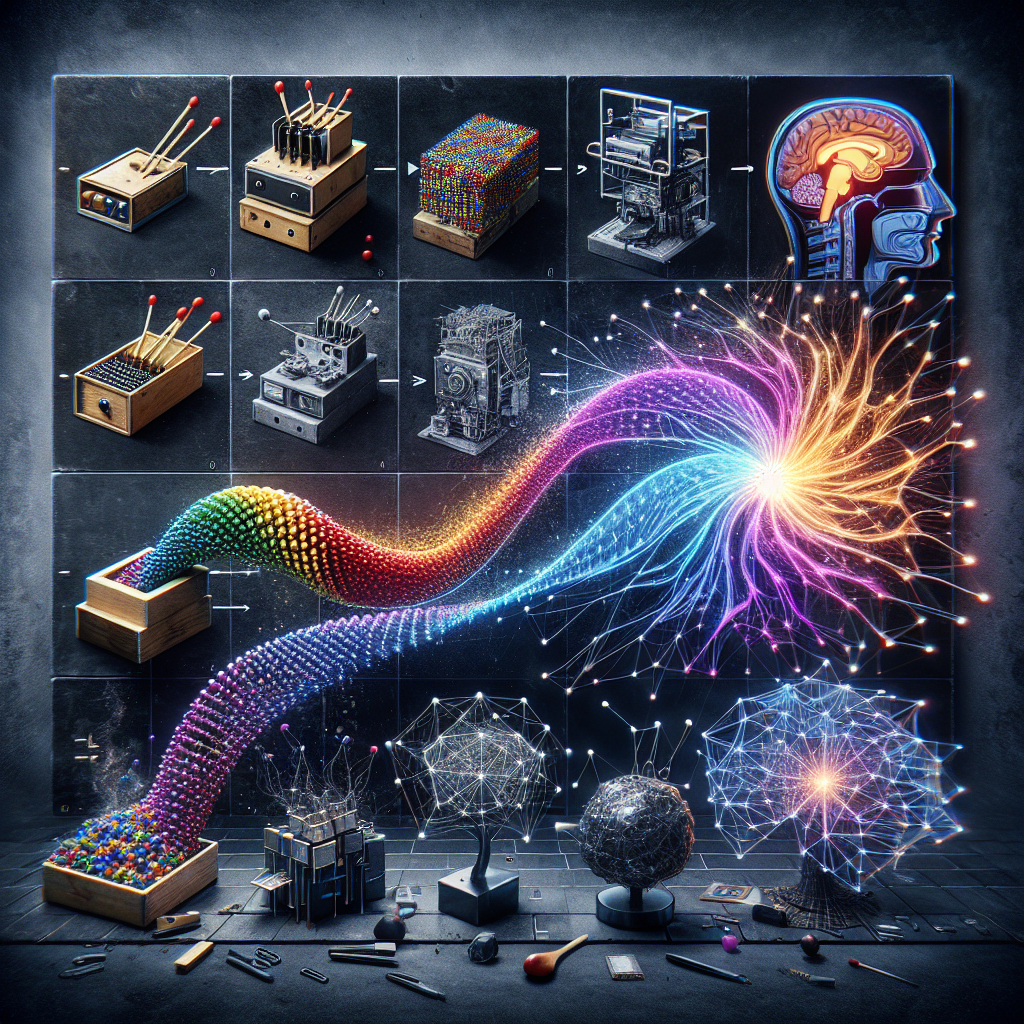
From the mid-20th century to the present, artificial intelligence has evolved from primitive pattern recognition systems to complex language processing networks, with milestones including Donald Michie’s matchbox machine, Claude Shannon’s information theory, Frank Rosenblatt’s Perceptron, and the development of modern neural networks and ChatGPT-like technologies by OpenAI.
The Evolution of Artificial Intelligence: From Matchboxes to Neural Networks
Artificial intelligence (AI) has evolved from simple pattern recognition systems to complex language processing networks over the past century. Pioneers like Donald Michie, Claude Shannon, and Frank Rosenblatt laid the groundwork for the sophisticated neural networks and AI systems we see today. Their contributions highlight the remarkable journey of AI, from primitive beginnings to tools capable of generating human-like language and solving complex problems. Insights into this journey not only reveal the technical milestones but also pose critical questions about the future of AI and its potential to reshape society.
Donald Michie and the Birth of Machine Learning
The story of AI begins with Donald Michie’s matchbox machine, a physical model of reinforcement learning. In the 1960s, Michie developed a system using matchboxes and colored beads to teach a machine to play Tic-Tac-Toe. Each matchbox represented a game state, and the beads represented possible moves. The machine learned by adjusting the number of beads based on wins or losses, effectively teaching itself how to play.
This system was a rudimentary form of what we now call reinforcement learning, a method where algorithms learn by trial and error, receiving rewards or penalties based on their actions. Michie’s matchbox machine demonstrates an essential aspect of AI: the ability to learn from feedback. Despite its simplicity, it presents a foundational concept that underpins much of modern AI—the idea that machines can improve their performance through interaction with their environment.
Michie’s approach was groundbreaking because it showed that, even without advanced technology, a physical system could mimic basic learning processes. This idea paved the way for more sophisticated algorithms, which eventually led to the development of neural networks capable of handling complex tasks beyond game playing.
Claude Shannon and the Foundations of Information Theory
Claude Shannon, the “Father of Information Theory,” revolutionized the field with his 1948 paper, “A Mathematical Theory of Communication.” His work laid the groundwork for understanding how information is transmitted, processed, and stored, influencing fields from telecommunications to artificial intelligence.
Shannon’s most significant contribution was the idea that language could be modeled as a statistical sequence of predictions. By treating language as a series of interdependent probabilities, he provided a theoretical framework for developing language-processing algorithms. Today, these principles form the basis of natural language processing (NLP), where AI systems excel at predicting the next word in a sentence based on the available context.
This approach transformed the way scientists approached language understanding, leading to advanced systems that can parse, interpret, and generate text. Shannon’s work shows that understanding language is fundamentally a problem of patterns and probabilities, an idea that remains central to the development of language models like GPT-4.
Frank Rosenblatt and the Perceptron
In 1958, Frank Rosenblatt created the Perceptron, the world’s first artificial neural network. Built using electrical components, the Perceptron mimicked the neuronal connections in the human brain. It learned by adjusting the strength of connections between its components, a process akin to synaptic plasticity in biological brains.
The Perceptron’s design allowed it to learn from data, recognizing patterns in simple visual inputs like squares and circles. Its ability to classify objects marked the first step toward creating machines capable of learning and adapting to new information. Moreover, this model laid the foundation for modern neural networks, which have become the backbone of contemporary AI systems.
Though the Perceptron itself was limited in its capabilities, it established a critical principle: machines could learn from experience and improve their performance over time. This realization has driven the development of increasingly sophisticated neural networks, capable of handling tasks varying from image recognition to natural language processing.
Japanese and European Innovations in AI Hardware
During the early 1980s, countries like Japan and Europe pushed the boundaries of artificial intelligence through innovative hardware projects. Japan’s Fifth Generation Computer Systems (FGCS) aimed to create advanced knowledge-based processors and significantly enhance computing speeds. Similarly, Europe’s ESPRIT program sought to improve Europe’s technological competitiveness by fostering collaborative research among institutions, industries, and academia.
Japan’s FGCS project, led by the Institute for New Generation Computer Technology (ICOT), combined parallel processing and logic programming to produce systems capable of rapid logical inferences. The project developed significant demonstrations, such as parallel inference machines and a logic-based intelligent programming system, advancing the fields of concurrent logic programming and parallel computing theory. Despite its ambitious goals, FGCS fell short in achieving commercial success but left a lasting impact on AI research.
On the other hand, Europe’s ESPRIT initiative resulted in advancements in expert systems and neural networks. Supported by the European Commission, this program cultivated a collaborative environment for academia and industry, promoting the development of competencies essential for AI research. While being less centralized than Japan’s FGCS, ESPRIT contributed an important framework for future European technological innovations.
Postal Service Letter Recognition and Early AI Applications
Surprising as it might seem, one of AI’s early applications was enhancing the efficiency of postal services, particularly by the U.S. Postal Service. The initial efforts focused on detecting patterns in handwritten letters while employing simple algorithms to match letters with their intended addresses. By analyzing various properties such as slope, curvature, and spacing, algorithms built in the early 1980s predicted the likelihood of each letter belonging to a certain category.
This recognition technology laid the groundwork for advanced digital algorithms, ultimately leading to robust optical character recognition (OCR) systems. It exemplifies the progress over the years, from basic pattern recognition models to intricate neural networks capable of interpreting complex handwriting.
While seemingly modest compared to modern applications, postal letter recognition provided critical evidence of AI’s potential in automating labor-intensive tasks, laying essential foundations for current innovations—such as natural language processing and image recognition—that now surpass human performance in various domains.
From the primitive beginnings of the matchbox machine to advanced systems like ChatGPT, artificial intelligence has made significant strides in mimicry and learning. These milestones shaped the advanced tasks that modern AI systems perform today, presenting an ongoing evolution that is only set to continue into the future. Such developments raise imperative discussions concerning the ethical, philosophical, and practical implications of intelligent system integration—reminding us of its genuine capability to reshape human lives profoundly yet respecting the necessity of careful consideration and regulation.
Here are the notable pioneers mentioned in the article, along with their contributions to the development of AI:
- Donald Michie –
- Contribution: Developed the Matchbox Educable Noughts and Crosses Engine (MENACE), an early example of machine learning through a physical reinforcement learning system for playing Tic-Tac-Toe.
- Frank Rosenblatt –
- Contribution: He introduced the Perceptron in 1958, one of the first artificial neural networks. His work used transistors to mimic neuronal connections, demonstrating basic pattern recognition through learning.
- Gerald Tesauro –
- Contribution: Created a neural network in 1992 to play Backgammon, which learned to predict winning board patterns through self-play and reinforcement learning signals, discovering strategies that surprised even expert players.
- Yann LeCun –
- Contribution: In the late 1980s, demonstrated the potential of neural networks for practical applications by training them to recognize handwritten digits, significantly advancing the field of deep learning for practical use.
- Claude Shannon –
- Contribution: Known as the father of information theory, his work in the 1940s helped conceptualize language as sequences of predictions, influencing how AI could process and predict language.
- Andrej Karpathy –
- Contribution: In 2015, showed that neural networks could not only predict but generate text patterns, setting the stage for more advanced language models by demonstrating the power of training networks on large text corpora.
- Alex Radford (at OpenAI) –
- Contribution: Took text prediction experiments further by training larger networks on millions of reviews, leading to the development of the GPT series, which showcased how networks could understand and generate language with increasing sophistication.
These pioneers contributed foundational work from early machine learning concepts and hardware implementations to the sophisticated neural network models and language processing algorithms that form the backbone of modern AI systems.
This post contains affiliate links. If you purchase through these links, I may earn a commission at no extra cost to you.
Leave a Reply